Legal Center
The Brass VerdictThe Legal Center is a six-story office building on Broadway near Third Street, close to downtown Los Angeles’s criminal and civil courthouses. Its tenants include trial lawyers, and its adjoining parking garage is where Jerry Vincent was killed. The building becomes central to Mickey Haller’s inheritance of Vincent’s legal practice and to the investigation of the murder: its offices are places of work and legal conflict, while its garage and entrances hold the threat of violence.
Setting and Layout
The building’s location reflects its professional purpose. As Haller observes, proximity to the main downtown courthouses has made the Legal Center a place filled with trial lawyers. The Legal Center is not simply an address for Vincent’s office; it sits within the daily geography of criminal and civil litigation, with the courthouse nearby and a garage connected to the office floors.
The garage has its own entrances into the building at each level. That arrangement matters to Haller’s movements: on an early visit, he drives past the second floor, where the police have not yet cleared the murder scene, and eventually parks on the fifth floor. On a later morning, he deliberately parks on the second level, the same floor as the office. The connected levels make the garage a route between the street and the law offices, but also a space in which Haller can be exposed before reaching the relative security of the workplace.
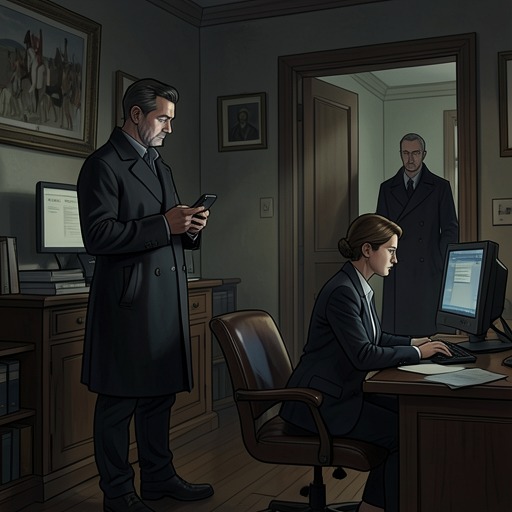
Vincent’s office is on the second floor at the front of the building. Haller finds its opaque-glass door closed but unlocked, opening into a reception room with a counter and a waiting area. Behind the counter, Vincent’s employee is visibly upset and initially mistakes Haller for someone with the police. The office’s front-facing position and the corridor leading to it later place its entrance within the reach of a pursuer who follows Haller inside.
Vincent’s Office and the Transfer of His Practice
After Vincent’s death, the Legal Center becomes the practical starting point for Haller’s new responsibilities. A court order and Vincent’s earlier arrangements make Haller the first lawyer entitled to take over Vincent’s cases, including Walter Elliot’s, although each client remains free to choose another attorney. Haller goes to the Legal Center to assume that work and to meet with his investigator, Cisco Wojciechowski, whom he trusts and expects to help locate the new clients.
Vincent’s office gives the transfer a physical setting. Haller finds a large, opulent room that is empty of people, with a mounted fish above a dark-wood credenza and a brass plaque beneath it. The plaque bears the words “IF I’D KEPT MY MOUTH SHUT I WOULDN’T BE HERE.” The display is a specific, unsettling feature of the room that Haller enters as he takes over the practice; its warning about silence gains force in a story shaped by client confidentiality, concealed information, and Vincent’s killing.
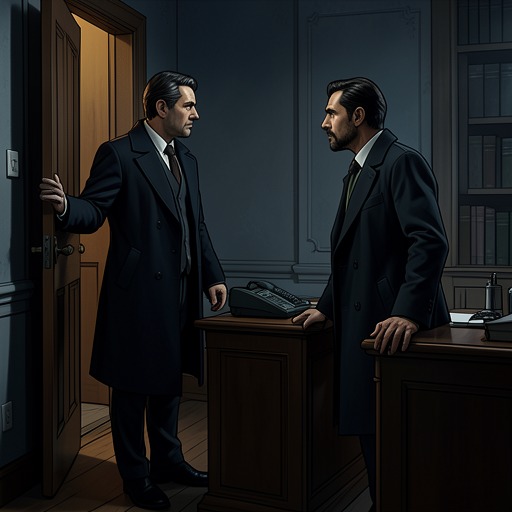
The transfer also produces an immediate dispute over who controls the office and its files. A detective claims the office as part of the crime scene and says that he can shut it down and seal it. Haller refuses to leave, arguing that the murder scene is in the garage and that a judge would not extend the police cordon to the office and its files. He relies on the court order and insists on taking care of his clients. The disagreement makes the Legal Center a boundary between a murder investigation and the continuing obligations of legal practice: the police seek access and control, while Haller asserts his right to represent the people whose cases he has inherited.
The Garage and the Murder Investigation
The police presence makes clear that Vincent’s murder occurred in the building’s garage. When Haller arrives, an officer checks his identification and records his name and driver’s-license number. The officer tells him that parking is unavailable on the second level because the scene has not been cleared. From the ramp, Haller sees two patrol cars, Vincent’s black BMW coupe being loaded onto a truck, and officers beginning to take down the yellow crime-scene tape. Although detectives are not visible at that moment, the police have not yet relinquished the location.
The building’s entrances also become part of the evidence. Harry Bosch shows Haller a grainy surveillance still taken from video of the Legal Center’s front entrance. It shows a man leaving through the building’s front door; the image is distant and unclear, but Haller notices what appears to be a pistol tucked into the man’s waistband. The entrance thus links the office building’s ordinary comings and goings to the search for Vincent’s killer, while the poor quality of the image leaves recognition uncertain until Haller encounters the man himself.
Recurrence and Narrative Significance
On a later Thursday morning, Haller returns early and parks on the garage’s second level, near the spot where Vincent had been parked when he was shot. In the same garage, he notices a Subaru station wagon with surfboard racks and belongings packed into the rear; Patrick Henson is asleep in the back, having been living out of his car. Haller leaves him undisturbed and crosses from the garage into the office complex. There, outside Vincent’s office door, Harry Bosch is waiting for him. The scene brings together the building’s different roles: it is a workplace inherited by Haller, a crime scene still shadowing the investigation, and a place where the lives of people connected to his work converge.
The most dangerous return follows Haller’s recognition of the man from Bosch’s surveillance photograph. As Haller leaves the office and enters the garage, he sees the man coming up the ramp and believes him to be Vincent’s killer, armed. Haller turns back toward the building, but the doors have locked behind him. He drops his wallet and other belongings while searching for his key, gets inside, and runs down the hallway to Vincent’s office. The pursuer catches the door before it closes. Haller reaches a gun Cisco has left in a desk drawer and faces the attacker through the office’s frosted glass. The route from garage to corridor to office, previously a routine passage between car and work, becomes a narrow sequence of escape and confrontation.
The Legal Center’s significance comes from this repeated crossing between professional continuity and physical danger. Haller claims Vincent’s office and cases through formal legal arrangements, contests the police effort to close the office, and returns to the building to continue working with Bosch. Yet the same property contains the garage where Vincent was killed and the entrance through which a suspect is recorded. By placing legal duties, investigative evidence, and the threat to Haller in connected parts of one building, the story makes the Legal Center more than a backdrop: it is the shared ground on which Vincent’s unfinished practice and murder investigation meet.